
The Polymath's Advantage
Polyvalency
Many ways of making connections.
The word comes from chemistry. A polyvalent atom bonds with multiple partners along multiple axes at once. My version keeps the bonding idea. Creativity lives at the joints between things that don't obviously belong together. Music and psychiatry. Theater and strategy. Jazz improvisation and organisational design. The interesting work happens where those fields touch.
Polyvalency is the skill of finding those joints and treating them as creative territory.
Specialisation rewards going deep on one logic. The cost shows up when a problem sits at the edge of that logic, or in the gap between two. A policy designer who only reads policy will miss what anthropology would catch. A founder who only reads business books will miss what history has already solved. The joints are where the work is.
Polyvalency is a disciplined practice. Read outside your field on purpose. Spend time with practitioners from unrelated disciplines and listen for the frames they use. Name the connections out loud, because unnamed connections evaporate. Treat analogy as a tool, not a garnish.
THE PRACTISE
-
Pick two fields that seem unrelated. Read one thing from each per week for a month. Pay attention to what they share and where they disagree. Both signals are useful.
-
When you catch yourself thinking "this is like…" stop and say it. Unnamed connections evaporate. Named ones compound.
-
Put someone who runs a lab next to someone who runs a theatre. Pay attention to what they talk about once the small talk runs out. That conversation is a preview of the work.
-
When you find a pattern that repeats across two or more domains, write it down. Over a year it becomes your personal pattern library. Over a decade it becomes a book.
IN MY OWN WORK
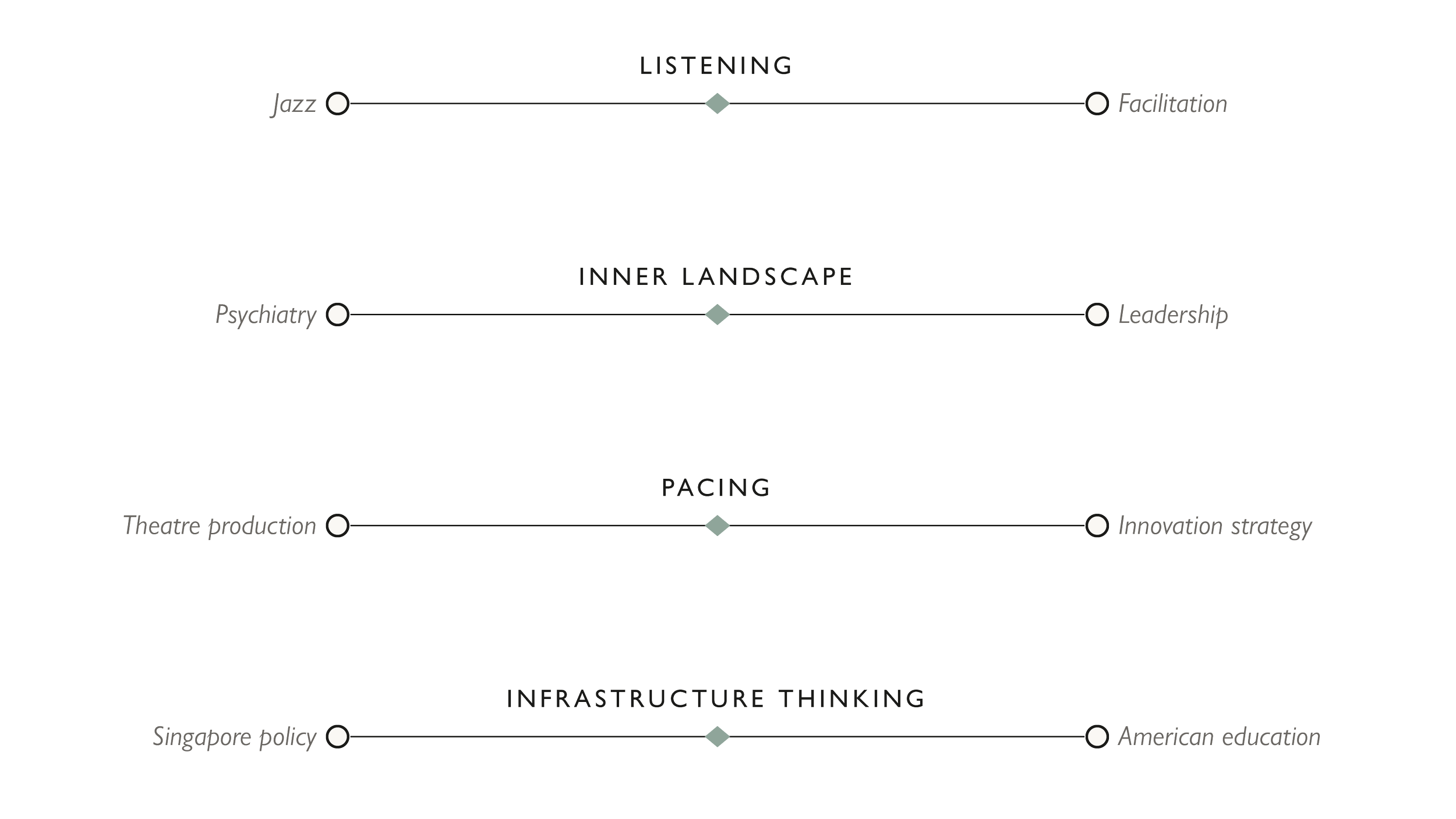
Jazz taught me about listening, which I brought to facilitation. Psychiatry taught me about inner landscape, which I brought to leadership. Producing theater taught me about pacing, which I brought to innovation strategy. The connections were not decoration. They were the work.
Innovation Nation in 2007 was built the same way. I took lessons from Singapore's industrial policy, brought them to American educational systems, and brought them again to corporate R&D. The same core pattern recurred across three very different domains: innovation needs infrastructure, not luck. Seeing that pattern meant holding three frames in mind at once without collapsing them into one.
THE THREE CAPABILITIES
Polycognition
Many ways of thinking. Analytical, intuitive, spatial, embodied, narrative, and emotional cognition working in parallel.
Polyvalency
Many ways of making connections. Seeing how music applies to organisational design, how psychiatry illuminates leadership.
Polytrophism
Many pathways to results. Not one right answer, but multiple routes to the same destination.

FOLLOW THE JOURNEY
A book, a course, a growing body of work, and a community of people re-imagining creativity for a new era. This is the beginning.