
THE POLY FRAMEWORK
The Polymath's Advantage
The Poly Framework
Three axes, operating together.
Most of what people call creativity today is a leftover from a simpler era. Pick a mode of thinking and defend it. Pick a discipline and stay inside its fence. Pick a path to the outcome and execute. That worked when the world held still long enough for a specialist to finish a task before the conditions changed.
The world no longer holds still. Computing went from binary to parallel. Crises went from single to cascading. Intelligence went from programmable to polymathic. The pattern repeats across the domains I work in: single systems giving way to multiples.
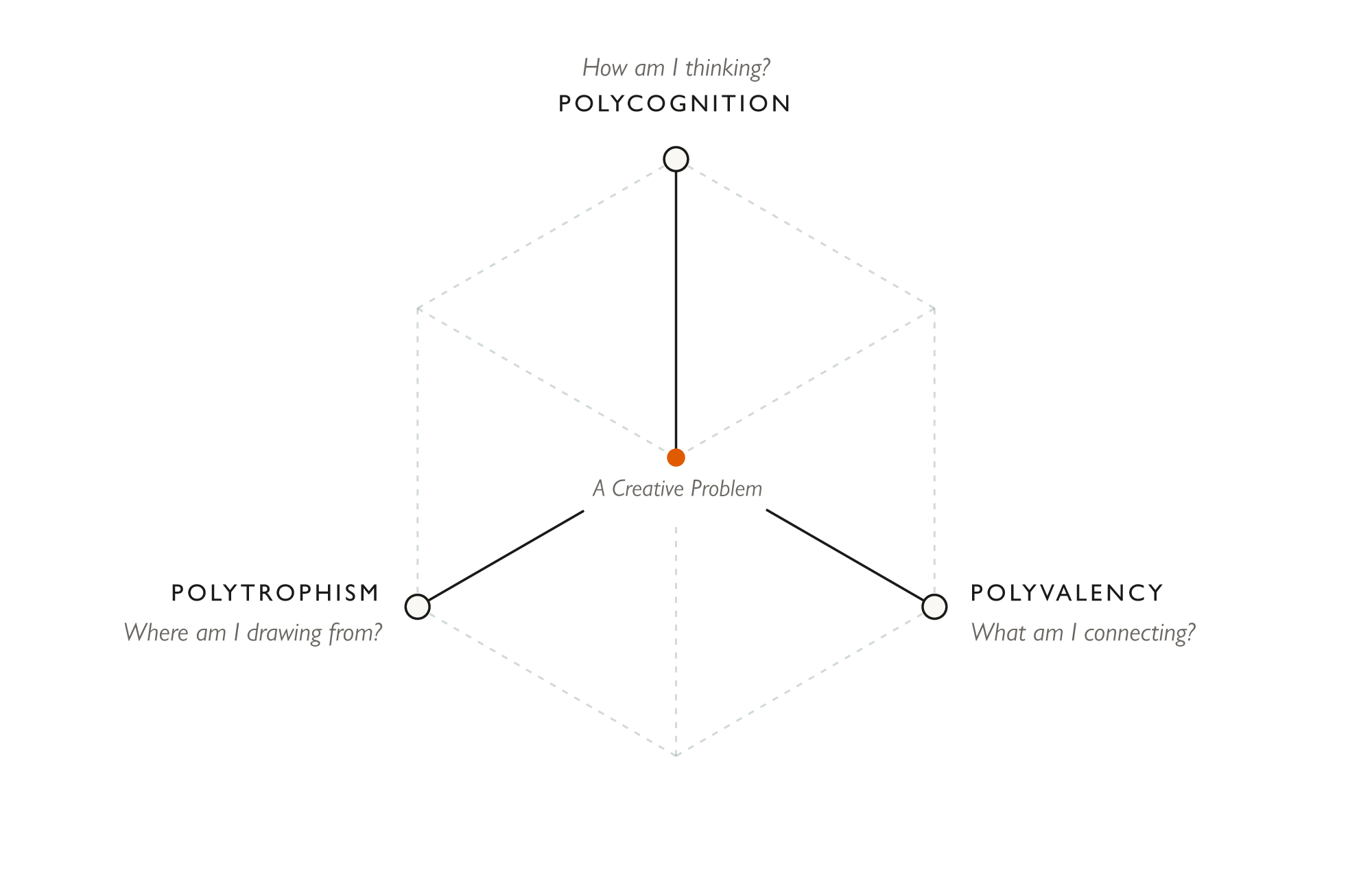
Creativity needs the same upgrade. Creativity for an age of complexity requires more than one mode of thinking, more than one way of connecting ideas, and more than one path to a result. The Poly Framework names what replaces the single-track defaults. Three axes, operating together.
Polycognition is about how you think. Analytical reasoning, intuitive pattern-matching, embodied knowing, metacognitive reflection, creative synthesis. Each mode catches what the others miss. A polycognitive thinker moves between them on purpose.
Polyvalency is about what you connect. Ideas, disciplines, people, and frames of reference each have their own logic. A polyvalent thinker finds the joints between them and treats those joints as creative territory.
Polytrophism is about where you draw your material. A single source runs dry. A single method hits conditions beyond its design. A polytrophic thinker keeps multiple routes live and knows when to switch between them.
Think of the three as a diagnostic. Pick any creative problem and ask:
Am I thinking about this in enough different ways?
Am I connecting this to enough different fields?
Am I drawing on enough different sources and paths?
If any answer is no, you have somewhere to go.
These three are trainable capabilities I've built through four decades of work across psychiatry, music, entrepreneurship, theater, and policy. Each has its own learning curve. Each has its own practice. The three get stronger in combination.
Start with whichever one speaks to the problem you're holding now.
THE THREE CAPABILITIES
Polycognition
Many ways of thinking. Analytical, intuitive, spatial, embodied, narrative, and emotional cognition working in parallel.
Polyvalency
Many ways of making connections. Seeing how music applies to organisational design, how psychiatry illuminates leadership.
Polytrophism
Many pathways to results. Not one right answer, but multiple routes to the same destination.

FOLLOW THE JOURNEY
A book, a course, a growing body of work, and a community of people re-imagining creativity for a new era. This is the beginning.