
The Poly Framework
Polycognition
Many ways of thinking.
I trained as a psychiatrist at Harvard, played keys with Frank Zappa, produced a Tony-nominated Broadway show, and advised four governments on innovation policy. Read that as a biography and it looks scattered. Read it as a method and it looks deliberate. I wasn't collecting hats. I was learning to hold multiple cognitive modes in one head and switch between them on purpose.
Polycognition names that skill. It is the capacity to make sense of the world by drawing on multiple modes of thinking at once, or in useful sequence. Analytical reasoning, intuitive pattern-matching, embodied knowing, emotional intelligence, creative synthesis. The point is not to stack them like tools in a drawer. The point is fluency, the ability to shift between them as the situation demands.
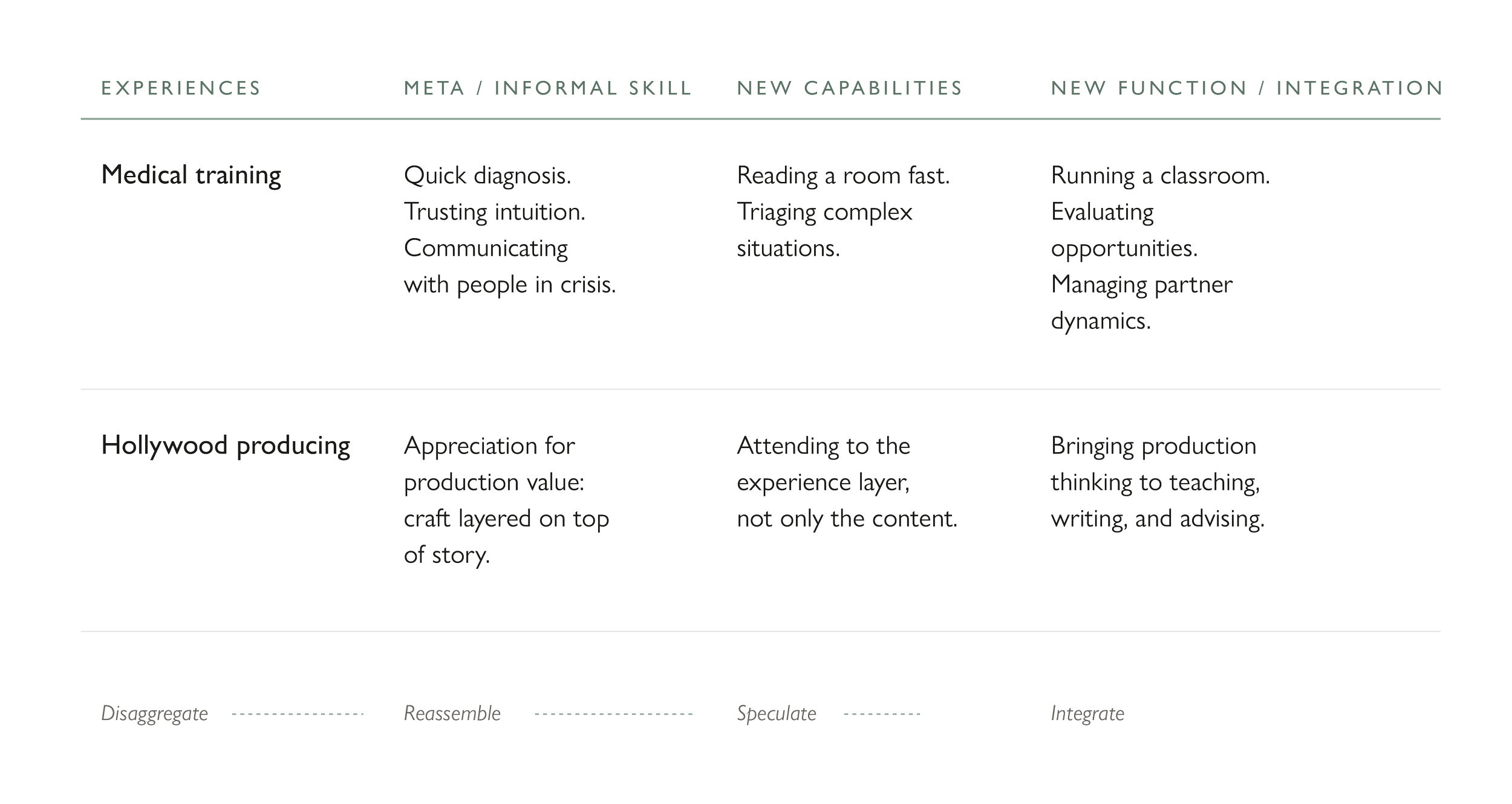
Polycognition grows from experience, but not the formal parts of experience. Medical school taught me drug dosages. The informal learning inside that training taught me how to make quick diagnoses, trust my gut, and communicate with patients mid-hallucination or with Massachusetts state troopers on a Saturday night. Hollywood taught me film producing. The informal learning there taught me about production value, the layer of care and craft added on top of a story. Those meta-skills transferred. They shape how I run a classroom, evaluate an opportunity, and work with partners. The formal content faded. The informal capacities stayed.
The age of complexity punishes single-mode thinkers. A climate strategist who can run a regression but can't read a room will miss half the politics. A product designer who can draft a user flow but can't feel the friction will ship something no one wants. Problems now arrive tangled across domains that don't share vocabulary. Use one mode and you miss what another would show you.
Polycognition is a working skill with a learning curve. You develop it by taking your own experience seriously as raw material. Not just what you were taught, but what you absorbed alongside the curriculum. Name those meta-skills. Let them come loose from their original context. Let them reassemble into something new.
The Exercise
Here's an exercise I use with my students. Simple in structure, open in outcome. The point is to take your own experience seriously as raw material and notice what's already there, waiting to be put to new use.
Make four column headings on a sheet of paper:
01
Experiences
02
Meta / informal skill
Start with experiences. Inventory the significant ones: a job in a particular industry, a sports team, a learning programme, a venture you started. Reflect on the informal or meta-level skills you built alongside the formal requirements. Let the inventory disaggregate and reassemble into novel patterns. Lean on liminal states and associative thinking. Speculate about what new integrations might open up. Have fun with it.
03
New Capabilities
04
New function / integration
THE THREE CAPABILITIES
Polycognition
Many ways of thinking. Analytical, intuitive, spatial, embodied, narrative, and emotional cognition working in parallel.
Polyvalency
Many ways of making connections. Seeing how music applies to organisational design, how psychiatry illuminates leadership.
Polytrophism
Many pathways to results. Not one right answer, but multiple routes to the same destination.

FOLLOW THE JOURNEY
A book, a course, a growing body of work, and a community of people re-imagining creativity for a new era. This is the beginning.